







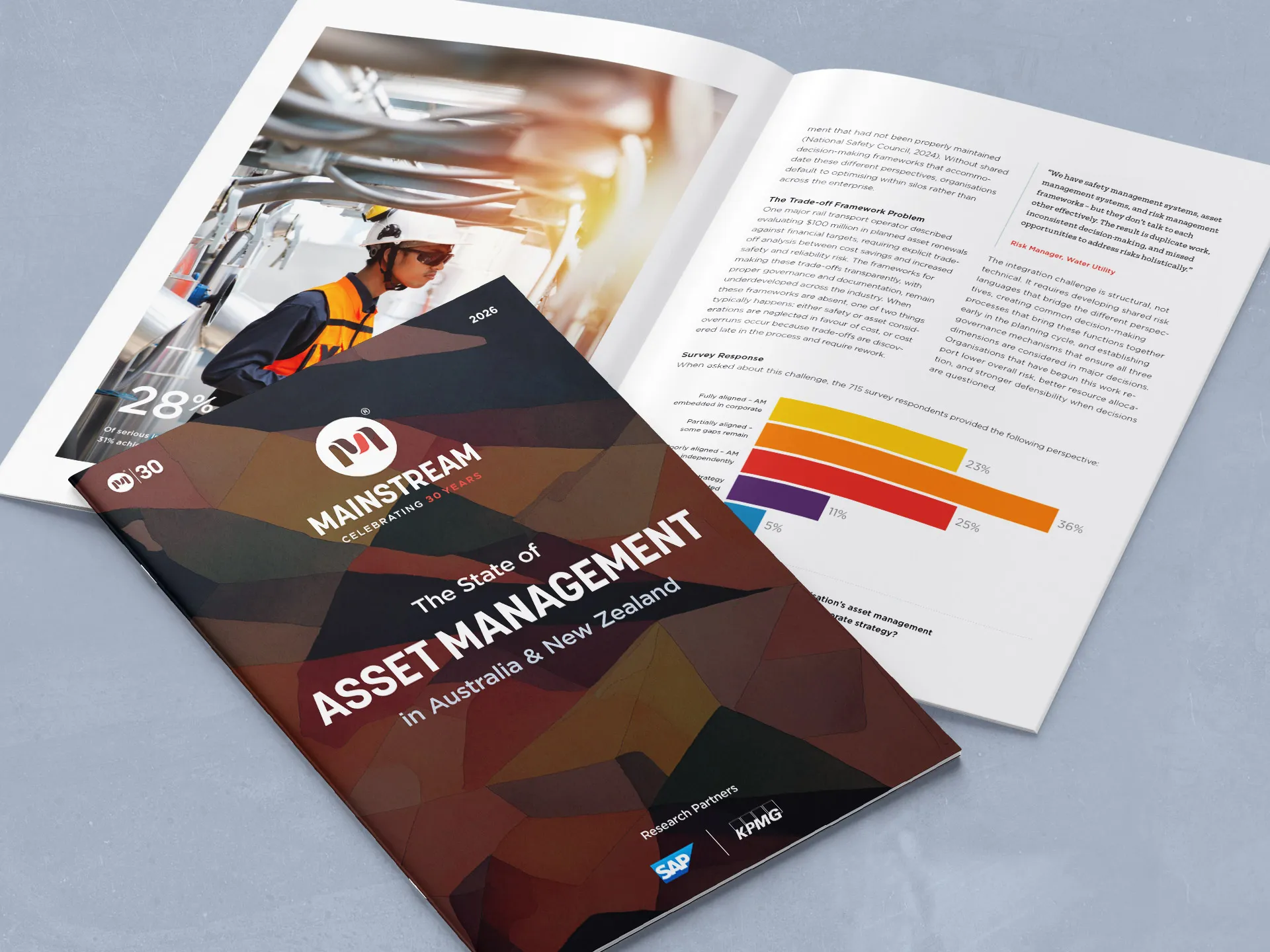
The State of Asset Management in Australia & New Zealand
Download your report to understand best practices, compare your companies’ performance and working environment to those inside and outside your industry, and make informed and effective decisions around your assets and your people.
Topics
For 30 years, MAINSTREAM has united thousands of Maintenance and Reliability professionals - building the largest body of practitioner intelligence on the challenges, breakthroughs, and opportunities shaping asset management excellence. These insights forge an agenda that empowers leaders and teams to benchmark against world-class standards, challenge conventional thinking across industries, and drive decisions that deliver measurable, lasting impact.
Download Report
Hot Topics
The Knowledge Exodus
With 25,000 engineers set to retire within five years and apprentice completions down 45% since 2012, the asset management profession faces a generational transition unlike any before it. Mean time to repair has risen from 49 to 81 minutes as experienced personnel leave, and 37 % of technical knowledge remains undocumented. The knowledge most at risk is contextual judgement – the engineer who recognises an abnormal bearing sound, the planner who recalls a supplier failure from ten years ago. This is not the kind of expertise that fits neatly into a procedure manual. Yet there are reasons for optimism. Over half of practitioners are already using generative AI for knowledge management tasks, and 35.8 % see knowledge capture as AI’s greatest opportunity. Organisations that reframe knowledge sharing as professional contribution rather than replacement are seeing stronger engagement. The window for structured capture is narrow, but it is open.
Data Abundance Without Insight
The profession has largely solved the problem of data collection – and comprehensively stalled on the problem of data conviction. 78% of organisations collect more maintenance data than they can effectively analyse. 67% do not trust their own data enough to act on it. Professionals spend 14.6 hours per week – nearly 40 % of their available time – searching for, validating, or reconciling information across fragmented systems. The result is a parallel information economy where official systems hold incomplete records and real operational knowledge lives informally in people’s heads. The organisations making progress treat data quality as a continuous operational discipline, not a one-off remediation project. Appointed data owners, standards aligned to ISO 14224, and enforcement at the point of entry are proving effective. The opportunity is significant: organisations that get this right build the foundation for every analytical capability that follows – from predictive maintenance to AI-driven decision support.
AI Pilot Purgatory
Artificial intelligence has moved from conference speculation to operational reality, but most organisations remain caught between aspiration and execution. Nearly 45% have not yet started with AI, a further 44% are in pilot or early implementation, and 76% of projects fail to deliver expected returns. The most widely adopted application is generative AI for everyday knowledge and productivity tasks, with 52.5 % of respondents already using these tools. Predictive maintenance ranks second at 37.5 %. Workforce AI skills score lowest of any readiness dimension at 2.69 out of 5, while leadership ambition sits higher at 3.34 – a gap that needs closing. 85% express concern about younger engineers over-relying on AI outputs. The real opportunity, however, is substantial: rather than optimising existing processes for marginal gains, AI enables organisations to reinvent how maintenance works entirely – dynamic, responsive, and tied to actual operating conditions. Getting there requires investing in clean data, integrated systems, and workforce capability first.
The Execution Discipline Gap
Perhaps the most persistent finding across thirty years of this research is also the most actionable: the profession knows what good looks like and has not yet consistently executed it at scale. Only 41 % report high compliance with planning and scheduling procedures, and 45 % cite lack of resources as the primary barrier. The root causes are organisational and cultural – competing priorities, diffused accountability, and the invisibility of maintenance outcomes that succeed precisely because problems were prevented. The encouraging news is that the path forward requires no new knowledge. Organisations achieving high compliance share a consistent pattern: simultaneous attention to process, technology, and behaviour, with explicit leadership accountability at every level. One water utility achieved stable planned maintenance rates above 70 % over four years through structured KPIs and daily adherence reviews – not new technology, but new discipline.
The Middle Management Bottleneck
Across multiple roundtable sessions, a consistent and largely unaddressed barrier to transformation emerged: middle management. Senior leadership endorses strategic change. Frontline workers understand the need for it. But the layer in between – where 71 % report feeling overwhelmed and spans of control have grown to 12.1 direct reports – is where transformation often stalls. Middle managers are accountable for operational performance under existing systems while being asked to champion change that introduces uncertainty. Their scepticism is rational when new approaches add complexity without clearly making their roles more effective. Misaligned performance metrics compound the challenge. A manager measured on cost reduction will naturally resist initiatives requiring investment. The organisations achieving breakthrough results have found a clear formula: enrolling middle managers as design partners from the outset, removing conflicting accountabilities, and changing what gets measured and rewarded. When middle management is engaged rather than bypassed, transformation gains traction.
Workforce Wellbeing and the People Metrics Gap
Every participating organisation could produce detailed data on asset condition, failure rates, and maintenance costs. Almost none could provide equivalent data on workforce fatigue, burnout risk, or workload sustainability. 64% report increasing mental health challenges among maintenance personnel. For FIFO workers, 33% experience depression or anxiety above clinical cutoff. Mental health claims average 35.7 lost weeks compared to 7.4 for all claims. Meanwhile, women represent just 16.8% of the maintenance workforce, and half of female engineering graduates leave the profession within a decade. These figures point to both a responsibility and an opportunity. Organisations scoring highly on Organisational Health Index assessments show strong correlations with team performance, stability, and retention – suggesting that investment in wellbeing and inclusion may represent one of the highest-return investments available. Practical steps are already proving effective: changing job titles to attract broader applicants, introducing flexible work arrangements, and building visible career pathways are expanding the talent pool in measurable ways.
Strategic Misalignment and the Language Barrier
Only 23% of organisations believe their asset management strategy is fully aligned with and understood across the broader business. 67% say their organisations prioritise short-term cost reduction over long-term asset performance, and just 26 % have formal mechanisms to translate corporate strategy into asset management plans. The barrier is not resistance but incomprehension – technical teams and executives speak fundamentally different languages, and neither side has built adequate translation mechanisms. Asset managers talk reliability and failure modes; executives talk market share and shareholder returns. The disconnect has measurable consequences, with asset failures routinely traced back to strategic misalignment. Yet the organisations closing this gap demonstrate that it is solvable. When asset management professionals frame technical requirements in business language – uptime as revenue, reliability as customer satisfaction, maintenance strategy as contribution to enterprise outcomes – they gain a seat at the strategic table. The profession’s ability to communicate its value, not just deliver it, is becoming a defining capability.
System Fragmentation and the Data Trust Deficit
Organisations operate an average of 8 to 12 separate systems containing critical asset information, yet only 26% achieve meaningful integration between them. Engineers rate their confidence in asset data at 5.8 out of 10. While 91 % view data as a strategic asset, only 34% have implemented formal governance frameworks. The operational data that matters most for maintenance decisions is consistently the hardest to integrate – one utility reported full finance data integration but only 30 % of work data connected. Post-merger or acquisition integration also compounds the challenge, creating data debt that technical solutions alone cannot resolve. The organisations making headway start with governance rather than technology: appointing data owners with clear accountability, establishing standards aligned with frameworks, enforcing discipline at the point of entry, and monitoring data quality as an ongoing operational metric.
The Apprenticeship and Training Pipeline Crisis
A twenty-year gap in apprenticeship investment, driven by boom-bust cycles, has created a pipeline shortage that cannot be closed quickly. Trade commencements have fallen 15.3 % year-on-year, and apprentice completions dropped from 485,440 in 2012 to 267,385 by 2024. Australia needs 83,000 additional tradespeople. The timing mismatch is structural: infrastructure investments run on decade-long cycles, training requires years of lead time, but career decisions respond to short-term economic signals. During downturns, apprenticeships contract; by the time demand recovers, the gap is entrenched. Structural responses are now emerging. South Australia’s establishment of five new technical colleges, AUKUS-driven investment in defence trades, and new university pathways that blend practical and theoretical learning all represent progress. Some organisations are experimenting with accelerated apprenticeships and competency-based progression rather than time-served models. The most effective strategies pursue three tracks simultaneously: retaining and motivating existing staff now, accelerating training for mid-career workers, and rebuilding the long-term pipeline through partnerships with educational institutions.
Safety, Risk, and Asset Management Silos
Safety, risk, and asset management are inherently interconnected, yet only 28% of organisations have achieved substantial integration between them. These functions operate in separate systems, use different risk languages, and report through different hierarchies. Asset managers think in fifty-year asset lives; safety professionals respond to immediate incident risks; finance teams operate on quarterly cycles. 27% of serious workplace incidents have maintenance-related contributing factors, and maintenance deferrals to meet financial targets can increase safety risk without anyone explicitly evaluating the trade-off. One rail operator described evaluating $100 million in planned asset renewals against financial targets – the kind of decision requiring transparent trade-off frameworks. Organisations building these frameworks are seeing real benefits: shared risk languages that bridge perspectives, joint planning processes that bring functions together early in the cycle, and governance mechanisms that ensure cost, reliability, and safety are weighed together. Those that have implemented integrated governance report lower overall risk, better resource allocation, and stronger defensibility when decisions are questioned.
Decarbonisation and the Asset Transition Challenge
The energy transition is reshaping asset strategy at a pace that demands new thinking from maintenance and reliability professionals. 84% of large industrial companies have set emissions reduction targets, and an estimated $893 billion in asset modification or replacement is needed by 2050. The core challenge is not decarbonisation itself but managing the transition – maintaining complex hybrid portfolios where traditional and low-carbon assets operate simultaneously, each with different failure modes, maintenance requirements, and staffing needs. Team understanding of decarbonisation averages just 3.1 out of 10, and 82 % anticipate significant workforce capability gaps in low-carbon technologies. Forward thinking organisations share clear characteristics: they involve maintenance professionals early in decarbonisation planning, invest in training well before new assets arrive, and develop explicit transition plans for the hybrid period. Forward-thinking leaders are reframing decarbonisation not as a cost burden but as a catalyst to fundamentally redesign asset strategy, work patterns, and team structures for the technologies ahead.
Shutdown and Turnaround Excellence
Shutdowns can consume 25 to 60% of annual maintenance budgets and represent some of the highest-stakes operational events in heavy industry – one iron ore operation loses $2 million per hour during downtime. Yet only 32% of shutdown projects are successfully implemented, 80% exceed budgets by at least 10%, and 90% experience scope creep. The most consistent challenge is scope control: organisations enter shutdowns with defined defect lists only to discover significantly more work once equipment is opened. Contractor incentives can compound the issue, with scope expansion driven by the impulse to place available labour. However, the organisations achieving shutdown excellence are demonstrating what disciplined execution looks like. The 30/30 escalation rule has delivered more than 10% uplift in tool-time per shift. Clear commercial controls like management overhead capped at 15%, and supervision at 20%, enforce financial discipline. Real-time performance dashboards are enabling course corrections during shutdowns rather than after them. The path to consistent shutdown success starts with distinguishing between planning and preparation, building in contingency for inevitable scope discovery, and leadership that owns execution accountability.


